

Note: This article is part one of a series by Brett Fawcett on the history of our Catholic schools.
Introduction
When you belong to an institution with a history that you are proud of, it’s easier to be passionate for that institution. It is ennobling to carry on an honourable legacy. Conversely, it can be hard to get excited about something if you don’t know much about it.
I say all this because I get the impression that most people in Alberta do not understand the historical reasons why section 17 of the Alberta Act 1905, itself rooted in section 93 of the Constitution Act 1867, enshrines a right to fully publicly funded Catholic schools, formally called “separate schools”. I’m convinced that the reason many people are apathetic about the existence of separate schools–and the reason some people passionately want them all shut down–is because of simple historical ignorance about why that provision exists.
G.K. Chesterton once said that if you find a fence and can’t tell why it’s there, your first action should not be to simply tear it down, but to first figure out why it was set up in the first place. In the case of separate schools, however, the story you normally hear about why they were instituted is incorrect.
The typical claim is that Canada only protected separate schools as a concession to its French-speaking population so that it could win their support for the cause of confederation. Now that Quebec has largely lost its faith and, since 1998, has not had separate Catholic education, this concession (critics say) has outlived its usefulness, and we can therefore safely get rid of the anachronistic institution of having the government run two school systems.
This, as we shall see, is oversimplified at best and outright false at worst. It would take an entire book to flesh out the true story of how Catholic schools came to have the status that they do in Alberta. However, a (relatively) quick overview of the true story may serve to not only dispel that myth, but also to reveal that section 17 did not only emerge out of political calculation but also out of a profound understanding of justice, freedom, and diversity in the face of racism and oppression.
The First Separate School
In 1791, the British Parliament passed the Constitutional Act, also called the Canada Act, which more-or-less created the provinces of Ontario and Quebec, then called Upper and Lower Canada, respectively. Laws regulating education in both provinces came soon afterwards. Before this, churches, religious orders, and missionaries had largely been in charge of teaching children; now, the government took a more active role in providing and controlling schools.
In 1816, Upper Canada passed the Common School Act, which provided for government-funded, non-denominational schools–what we would today call “public schools.” It must be recognized that, historically, the common school system developed in part out of a desire for the government to make populations more culturally homogenous, and thus more easy to control. Part of this means using the public school system to assimilate minority groups into the dominant worldview. (Charles Glenn argues in The Myth of Common Schools that common schools essentially took over the role once played by national churches.)
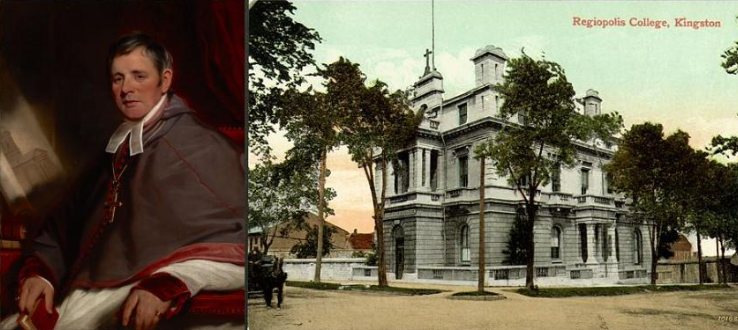
However, Upper Canada also funded some Catholic schools because of one man: Bishop Alexander Macdonell.
Before being raised to the episcopacy, Father Macdonell had been a priest in the Scottish Highlands who had successfully petitioned the British government to recruit his parishioners into their army. Father Macdonell thus created the first Catholic regiment in the British army since the Reformation, and was the first Catholic chaplain in the British army since the Church of England broke from Rome.
Father Macdonell and his men showed so much valour fighting for Great Britain that they were rewarded with land in Upper Canada, where he was made the first bishop of Kingston. The government was so grateful for his service that in 1816, the same year the Common School Act was passed, he was allowed to appoint four schoolteachers, whose salaries would be paid for by the provincial government.
His continued efforts to fight for support for Catholic education would result in him getting a royal charter to establish a secondary school called Regiopolis College in 1839. The following year, he died in Great Britain, where he had gone to solicit more funds for the College.
Right away, we can see that separate schools in Canada were initially founded by a Scottish bishop ministering to a community of transplanted Highlanders as a reward for his heroic service to the British Crown. The idea that this was just a concession to ambivalently loyal French Canadians is off to a shaky start.
Meanwhile, in Lower Canada, the Church provided most of the education, particularly for the poor. In 1801, legislation was passed instituting a “Royal Institution for the Advancement of Learning.” This Institute would be in charge of state-run schools where teachers would be paid by the government.
Bishop Plessis of Montreal organized a campaign against these schools, fearing that they were an attempt by the Crown to Anglicize and Protestantize the French Catholic population. The fact that the Royal Institute was the brainchild of an Anglican bishop who also happened to be its president only bolstered his case.
In response, an 1824 law allowed church councils (fabriques) to run their own elementary schools, which would be funded entirely out of parish revenue and would receive no money from the government. This allowed a parallel Catholic school system to operate alongside the state schools, though neither were fully “free” to parents.
In 1829, the Assembly School Act created something close to the modern public school system: Elementary Écoles de Syndic which were controlled by elected trustees rather than priests. The Church strenuously opposed these Legislative Assembly Schools, and, after gaining some concessions (such as an 1830 amendment allowing priests to be elected as trustees), were ultimately successful in having them shut down in 1836.
There was therefore precedent in both Upper and Lower Canada for a situation in which the government operated vaguely Protestant common schools alongside their church-run, legally recognized counterparts. After the tumultuous rebellions of 1838-1839 and the governmental restructuring that occurred in their wake, it was an open question whether those arrangements would continue.
Brett Fawcett teaches for Elk Island Catholic Schools at the Chesterton Academy of St. Isidore, and is a doctoral student at the University of Calgary.
This year, for just the second time in history, we were blessed to have the successor of St. Peter visit our home and province, Alberta.
The Holy Father came to us with a somber and humble purpose: to support the process of Reconciliation being undertaken in this country. He came here to listen firsthand to ‘hold a synod’ or ‘walk together’ with the Indigenous peoples of Canada [1]. In undertaking this journey Pope Francis follows the example of Christ in a most fundamental way; that, in the person of Jesus, God physically came to walk among us. He loves us, He wants to listen to us and be close to us.
In keeping with the spirituality of the ongoing Synod, and following this historic visit, the provincial Catholic education partners – ACSTA, CCSSA, GrACE, and the Bishops of Alberta – have decided to adopt the theme Walking Together in Catholic Education for the duration of the 2022-23 school year. Just like Pope Francis, we are all called to imitate Christ. The Holy Father tells us to “be shepherds with the smell of sheep”; therefore, we should ‘walk’ with the people we serve through our work in Catholic education – especially those with whom we seek reconciliation.
Of course, attempting to imitate Christ requires steadfast faithfulness to our God. This year the Congregation for Catholic Education issued the instruction The Identity of the Catholic School for a Culture of Dialogue, which states, quoting Pope Francis: “We cannot create a culture of dialogue if we do not have an identity”. To accompany and complement our 2022-23 provincial theme, then, we have also selected the following Scripture passage from the Book of Micah (chapter 4, verse 5):
As for us, we will walk
In the name of the Lord our God forever and ever.
While walking together we heed the words of the prophet Micah by remaining faithful and obedient to our God, as our Lord Jesus Christ exemplified so perfectly (Matthew 5:17).
On behalf of all the provincial Catholic education partners, we sincerely look forward to Walking Together in Catholic Education with you throughout the 2022-23 school year!
Notes:
[1] "To hold a ‘synod’ means to walk together.” 4 October 2013 Address of Pope Francis at the Cathedral of San Rufino in Assisi.

This article was originally published in the Fall 2004 issue of The Catholic Dimension, and is re-posted here for public reference.
Catholic separate school rights are constitutionally protected by virtue of s. 93(1) of the Constitution Act, 1867, section 17(1) of the Alberta Act, 1905 and section 29 of the Charter of Rights and Freedoms. The provisions of the School Ordinance, 1901, make it clear that at the time Alberta entered Confederation, Catholic separate ratepayers, now electors, had the right to establish Catholic separate school districts, and that once established, the trustees of that district had all of the "rights, powers, privileges and... liabilities" as set out with respect to public school districts, including the right to: engage and dismiss teachers; impose duties and obligations upon teachers; ensure that the schools operated according to the provisions of the School Ordinances, including those provisions protecting denominational education.
In order for a constitutional right to preferential hiring, promotion and denominational dismissal for cause to be protected, it must have been a right enjoyed by Catholic separate ratepayers by law at the time Alberta entered Confederation, and that right must relate to denominational education, or non-denominational aspects necessary to delivery of the denominational aspects of education. See PSBAA v. Alberta [2000], OECTA v. Ontario [2001], A.G. of Quebec [1991], and Ottawa Separate School Trustees v. Mackell [1917].
If these criteria are met, denominational education rights will be a defence to the enforcement of the provisions of the Human Rights, Citizenship and Multiculturalism Act and ss. 2(a) and 15 of the Charter of Rights and Freedoms as against a Catholic board.
Courts in Canada have unanimously agreed in Brophy v. A.G. of Manitoba [1895], Tiny Separate School Trustees v. The King [1927], Caldwell v. Stuart [1984], Daly v. Ontario A.G. [1997], and Hall v. Powers [2002], that Catholic education has a distinct Catholic denominational philosophy which fundamentally recognizes the duty of the Catholic Church to focus upon the formation of the whole person, according to the doctrine of the Catholic Church, attempting to achieve a synthesis of faith and culture fully permeated with the spirit and meaning of the gospel. The purpose and mission of a Catholic separate school is the inculcation of Catholicism in every aspect of the school, not simply in religion class, and the Catholic school that does not provide such a denominationally-focused education may be deprived of its separate school status. See Jacobi v. Aqueduct RCSSD No. 374 [1994].
Given this very distinct role of Catholic education, it is not surprising that the role of the teacher in the Catholic school is to emulate by personal example and modeling the teachings of the Catholic Church. In the Catholic philosophy of education, the teacher is required to live in "imitation of Christ" and to be a constant example of the teachings of the Church, not only in their words but in their conduct. They are required to be the "highest model of Christian behaviour" and to transmit the Catholic faith to their students through their personal example, beliefs, values, attitudes and lifestyle. It is this expectation which is incorporated in the contractual relationship between the teacher and the Catholic board, requiring that the teacher follow, both in and out of school, a lifestyle and deportment in harmony with Catholic teachings and principles. See Caldwell, supra, and Daly, supra.
It has been clear since the earliest days of Confederation that Catholic separate schools are entitled to preferential hiring; that is, the preference to hire Catholic teachers over others and the preference to require all teachers to live as examples of the Catholic faith. The Courts have found that such a preferential hiring right was in existence at the time of Confederation and has been legally recognized throughout history. More recently, the Courts have recognized the right of Catholic separate schools to terminate the employment of teachers for "denominational cause," including marrying in a civil rather than a Church ceremony, marrying a divorced person, or engaging in pre-marital sexual intercourse, as evidenced by requests for maternity leave. In addition, the Courts have recently recognized the right to preferential promotion of teachers to the positions of principal, vice-principal or departmental heads, on the basis of Catholic preference, if the promotion policy was a specific religious requirement necessary to maintain the denominational character of the school. See Re Essex RCSSB and Porter et al [1978], Caldwell, supra, Re Daly, supra, OECTA v.Dufferin-Peel RCSSB [1999], and Re Casagrande and Hinton RCSSD No. 155 [1987].
The standard to which a teacher in a Catholic school will be held is an elevated standard of Christian behaviour and requires attentive compliance in all aspects with Catholic teachings and principles. We live in a society in which others may behave in ways not always in strict communion with Catholic theology and doctrine. Teachers in Catholic schools are not expected to permit such relaxations of standards. They are held to a higher standard, not necessarily fair by societal comparison, but fundamental to the permeation of Catholic teaching in the Catholic school.
Where there has been a direct conflict between the provisions of human rights legislation, or sections 2(a) and 15 of the Charter of Rights and Freedoms, with denominational education rights preserved by section 93(1) of the Constitution Act, 1867, and section 17(1) of the Alberta Act, 1905, the Courts have resolved that conflict in favour of upholding denominational education rights, relying on section 29 of the Charter and the "special treatment guaranteed by the Constitution to denominational, separate or dissentient schools" even where those rights currently fit uncomfortably with other Charter guarantees. See Re Casagrande, supra, Mahe v. Alberta [1990] and An Act to Amend the Education Act (Bill 30) [1987].
Finally, the Courts have held that the constitutional rights enjoyed by separate Catholic schools are not frozen "as at 1905," but as educational modes and methods evolve, so do such rights. As a result, the recent phenomenon of reliance upon teacher assistants and other non-teachers in the classrooms, as an extension of mode or method of instruction in the classrooms, attracts the constitutional protections relevant to teachers as they existed in 1905. See Ottawa Separate School Trustees v. City of Ottawa [1915], Hirsch v. Protestant School Commission of Montreal [1928], Jacobi, supra, Ontario Home Builders' Assoc. v. York Region Board of Education [1996], OECTA v. Ontario, supra, and Bill 30, supra.

This article was originally published in the Spring 2000 issue of The Catholic Dimension, and is re-posted here for public reference.
The Charter of Rights and Freedoms
The Constitutional enactment which brought Alberta into confederation was the Alberta Act, 1905. Section 17 of that Act, section 93 of the Constitution Act 1867 and sections 41 to 45 of the Northwest Territories School Ordinance 1901, guarantee Catholic ratepayers the right to establish a separate school district, set assessments, collect taxes, permeate Catholicism in all aspects of education and enjoy all the rights, powers, privileges allowed to public school districts.
A history older than Alberta
On July 15, 1870, Canada assumed Rupert's Land from the Hudson's Bay Company, effectively gaining control over education in what is now Alberta and Saskatchewan. In 1875, the first North-West Territories Act was passed. Section 11, entitled public and separate school jurisdictions to establish. There were no restrictions on the geography of those school jurisdictions.
In 1884, the School Ordinance provide that a public or separate school district "comprise an area of not more than 36 square miles" (a 6x6). Separate school districts were not bound by the geography of public school districts. In addition, public or separate school districts could be expanded at the request of landowners. Under the School Ordinance of 1884, four Catholic Public boards (Fort Saskatchewan, St. Albert, St. Leon and Cunningham) and three Catholic Separate boards (Calgary, St. Joachim's (now Edmonton) and Bellerose) were established.
By 1886, the formation of separate districts was restricted to the boundaries of public school districts established on a 6x6 basis, and in 1887, the formation area for public districts, and therefore separate districts, was reduced to twenty five square miles (a 5x5).
By 1901, a separate school district could be established within the boundaries of any public school district established without reference to specific geography (1875-1884), on a 6x6 basis (1884-1887), on a 5x5 basis (1887-1901), or on any other basis allowed in the discretion of the Minister subject to protection of separate school constitutional rights. It was this right of establishment that was constitutionally protected in the Alberta Act, 1905.
Then, in 1913 the basic geography of a school district was again reduced, this time to a 4x4 area.
The 4x4: wrong assumption
For reasons unknown, it became assumed after 1913 that Catholic school districts could only be formed on the basis of 4x4s. This assumption persisted, despite the continuing evolution of public school geography.
In 1913, the Minister was enabled to create public consolidated school districts no longer bound by the 4x4 geographical jurisdictions. In 1916, the Minister was authorized to organize "any portion of the province into a district", so that districts could now be of any size or dimension. By 1919 consolidated school districts were allowed to include any territory of not less than 30 and not more than 80 square miles.
The first Schools Act of Alberta was passed in 1922. This Act recognized basic 4x4 school districts, larger basic school districts "in special cases", consolidated school districts and secondary consolidated school districts. In 1931, a new type of district was added to the jurisdictional list, the "rural high school district".
In 1966, the qualifying boundaries for school districts and consolidated school districts were repealed so the public school districts and consolidated school districts could be established without restriction as to geography. In 1970, the Minister was entitled to establish divisions of any number of public school districts.
In 1988, the Minister was confirmed in the right to establish any portion of Alberta as a public school district, or to establish divisions consisting of any number of public school districts. A separate school district could be established within a public school district and the Minister could by order add land to, or take land from, a district or division, or divide a district or division into two or more districts or divisions. There were no references in this act to specific geographical dimensions for districts or consolidated districts, as those references had been deleted in 1966.
Finally, recent legislative amendments, while preserving all of the above jurisdictions, added the concept of a regional division, either formed on a voluntary basis (School Amendment Act 1993) or forced basis (School Amendment Act 1994).
The 4x4: no foundations in law
There is no foundation in law to require separate school districts to be formed on a 4x4 basis.
Separate School districts were entitled to form between 1875 and 1884 without reference to specific geography; between 1884 and 1887 on the basis of 6x6 jurisdictions, but separate school districts need not have been based upon public school districts; from 1887 to 1913 on the basis of 5x5 jurisdictions; from 1913 to 1966 on the basis of 4x4 jurisdictions, and without restriction as to specific geography from 1966 to present. Yet, the practice continues; the Catholic ratepayer is legally and administratively directed to do just that.
There is no foundation in law for restricting separate school jurisdictions to the original 6x6/5x5 or 4x4 public school jurisdictions.
Public school districts were not limited to such original geographical restrictions. They included, beginning in 1913, consolidated school districts which by 1919 could be of no less than 30 square miles nor more than 80 square miles; from 1922, secondary consolidated school districts; from 1931, rural high school districts; and from 1970, regional districts. Even these larger jurisdictional areas became artificial, being subject to orders of the Minister adding land to, taking land from, conjoining districts, separating districts and otherwise altering the basic shape, configuration and size of these geographical areas. In addition, the Minister always had power and authority to create school jurisdictions without reference to specific geographical boundaries, subject only to the constitutional rights of separate school ratepayers.
There is no foundation in law for restricting formation of separate schools to the geography of public school districts, even including larger district jurisdictions.
The Supreme Court of Canada has made it quite clear that protection of minority educational rights is "itself an independent principle underlying our constitutional order" (the Quebec Secession case, 1998), that educational rights cannot be stereotyped by the type of educational jurisdictions and rights existing at confederation (in the case of Alberta; 1905) (Hirsch v. Montreal Protestant School Commissioners (1928), Greater Montreal Protestant School Board v. The Attorney General of Quebec et al (1989) and Reference re: Education Act (Quebec) (1993)). Likewise, separate school constitutional rights cannot be confined to literal wordings or stereotyped to avoid the purpose and intent of the protection of minority rights (Greater Montreal Protestant School Board v. The Attorney General of Quebec et al (1989), Ontario Home Builders' Assn. v. York Region Board of Education (1996)). Finally, the Supreme Court of Canada has said many times that the constitutional rights of separate school supporters cannot be restrictively interpreted so that they are "hollow rights" which cannot be effectively exercised in the modern context (Reference re: Bill 30 (1987), Attorney General of Quebec v. Greater Hull School board (1984), Greater Montreal Protestant School Board v. The Attorney General of Quebec et al (1989), Reference re: Education Act (Quebec) (1993), Ontario Homes Builders' Assn. v. York region Board of Education (1996)).
Hollow rights wholly illusory
To restrict separate school formation to the archaic boundaries of 6x6s, 5x5s or 4x4s, or even to the larger unified boundaries of consolidated school districts, secondary consolidated school districts, rural high school districts or regional districts, when public school jurisdictions are now comprised of divisions and regional divisions, is only to accord separate school supporters "hollow rights" which are "wholly illusory" with respect to the formation of their districts.
Constitutional protection
It was the intent, purpose and substance of constitutional protection that separate school supporters would be entitled to establish separate school jurisdictions in any area of the province of Alberta which was established and organized for public school purposes.
This purposive interpretation is not to be limited by archaic geographical boundaries.
The challenge
The challenge for Catholic schools now is formation or expansion on geographical areas unfettered by 86 years of administering the 4x4 assumption in Alberta. Perhaps we should envision coterminous boundaries with public school divisions or wards of public school regional divisions, or creative areas for separate school expansion limited only by the needs of separate school ratepayers and students. Perhaps it is time to seize the opportunity to bring separate school education to all Catholic students in Alberta. It would not be impossible for the government to make it happen; all that is required is the political will.
This article was originally published in the Fall 2011 issue of The Catholic Dimension, and is re-posted here for public reference.
We are currently In medias res: in the heart of the matter.
At the time of writing, Bill 18: the Education Act, 2011 is still in limbo. We do not know whether it will progress through legislative process in the fall session to recommence November 21, 2011, be delayed to the spring session, 2012, or die on the order paper; whether it will proceed unamended, receive minor drafting amendments, or be substantially revisioned.
Bill 18: the Education Act, 2011, was given first reading in the Legislature on April 27, 2011 and second reading was moved on April 28, 2011. The Legislature rose for the spring session on May 12, 2011 at which time there had been no debate on second reading.
Bill 18 constituted a fundamental rethinking and rewrite of the current School Act, reorganizing educational governance into the topics: access to education, opportunities for learning, responsibilities and dispute resolution, board powers and elections, structure of school authorities, and education professions. A number of the provisions are of significant concern in the Catholic community.
Section 71 of the Bill, and section 132(4) with respect to francophone regional authorities, provides that separate school residents may elect to vote or run for public school trustee, rather than separate school trustee. Separate school residents maintain their residence in the separate school division, maintain their declaration that they are of the minority faith, but are allowed the additional option to vote and run for public school trustee. No rights are lost to separate school electors; more rights are granted to them. Nevertheless, it is clear that public school electors are unhappy with this grant of additional rights to separate school electors and this may eventually lead to a request from public school electors that they be given the equivalent right to vote and run for separate school trustee, which would be constitutionally and unlegislatively unsound. This grant of additional rights to separate school electors benefits a very small minority within the Catholic community, is contrary to the “no choice” Court of Appeal decision in Schmidt and Calgary Board of Education (1996) and is rife with political and legal consequences now and in the future.
Sections 106 through 119 of Bill 18 establish a new model for formation of separate school districts, colloquially known as the “flower petal” formation. The first step in that formation would be a collaborative effort between the electors, separate and public school divisions to determine an establishment area. In lieu of agreement, the Minister may determine that the establishment area for a new separate school district be the area of the original public school district, together with those districts which are “contiguous” to the “public school district in which the initiating separate school electors reside” and are “located in the separate school region”, thus constituting the “flower petal”. This is an innovative and interesting provision which should be watched with an open mind, but also with caution.
However, these new establishment provisions fail to expressly preserve the traditional “4 x 4” establishment provisions, constitutionally protected by incorporation into section 17(1) of the Alberta Act, 1905 of the provisions of sections 41 through 45 of the School Ordinance, 1901. This constitutional benchmark must always be maintained as the recognized minimal protection for the establishment of separate school districts.
Sections 79 and 81 of the Bill provide for Ministerial appointment of trustees where two attempts to fill a vacancy on a board have been made and no nominations have been put forward, or to allow for the appointment of a trustee to represent First Nation students on the board. Those appointments do not seem objectionable in principle, as long as appointments to a separate school board are members of the denominational minority. This caveat should be expressly stated in the Bill.
Of more concern is the provision in section 95(1) that allows the Minister to establish a school division consisting of “any number of public school districts, separate school districts and school divisions”, which appears to allow a school division to be comprised of a combination of public school districts, separate school districts, public school divisions and separate school divisions. A public school division should only be comprised of public school districts or public school divisions, and a separate school division should only be comprised of separate school districts or separate school divisions, except where the public school division is a Catholic public school division, when it may also be comprised of Catholic separate school districts. This proposed amendment in Bill 18 may allow for rationalization in the Greater St. Albert area and the Sturgeon Valley, but would not otherwise allow “blended“ school boards.
Of significant concern is the provision in section 188(3) of the Bill, which allows the Minister, should space be available in a school building, to direct a board to make that space available to another board. This would be problematic if the Minister determined to direct a Catholic school board to provide space in one of its schools to a non-Catholic school board or vise versa, thus establishing a shared facility which would be contrary to ACSTA’s standing Facilities Covenant.
Another provision of interest is section 55 of Bill 18, which like section 50 of the School Act and section 11.1 of the Alberta Human Rights Act, allows a parent to request that a student be excluded from religious instruction. An exemption should be made to that provision for Catholic schools, where religious instruction or exercises comprise the totality of the school day, with the essential purpose of fully-permeating Catholic theology, philosophy, practices and beliefs, the principles of the Gospel and teachings of the Catholic Church, in all aspects of school life, including in the curriculum of every subject taught, both in and outside of formal religious classes, celebrations and exercises.
These and other provisions of Bill 18 require careful monitoring, and hopefully some necessary amendments in order to preserve the essential Catholicity of our Catholic schools, the right to efficient establishment of new districts, expansion of existing districts, and the maintenance of a truly Catholic education focused on the development of the whole child; mentally, physically, emotionally and spiritually. We are truly, therefore, in medias res.
Page 1 of 6